Barrier-free toilets enable people with physical disabilities to be more independent and safe in everyday life in sanitary facilities. But what really constitutes an accessible toilet and what needs to be considered when planning, building or retrofitting? Factors such as size and depth, seat surface and height, back support, folding support handles and toilet roll holders all play an important role. In this article, we will give you an overview of the correct dimensions - from movement areas and grab rail positions to seat height - and show you what planners and builders should pay particular attention to. Because correct planning means free access for everyone. And Armatron makes this possible!
Barrier-free WC: dimensions and requirements for greater inclusion
Barrier-free toilets are one of the key components of modern, inclusive sanitary facilities - both in public areas and in private homes. The correct dimensions are crucial to enable people with physical disabilities to use them safely and independently. That's why suitable solutions are important - especially when it comes to functionality, user-friendliness, freedom of movement and comfort. Armatron offers exactly that: our barrier-free WC models fulfil the highest quality standards and can be individually integrated into structural conditions. In addition, we always ensure compliance with binding norms and standards for the prescribed movement areas, reach heights and equipment details that apply in Switzerland. These include the SIA 500 for obstacle-free buildings. In this way, we not only create legal certainty, but also ensure that your sanitary facilities are equipped for the future in the long term - from new builds to retrofitting.
What requirements apply and what you need to bear in mind
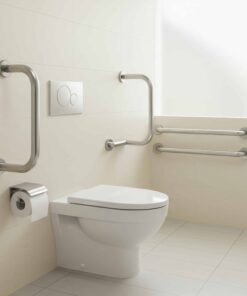
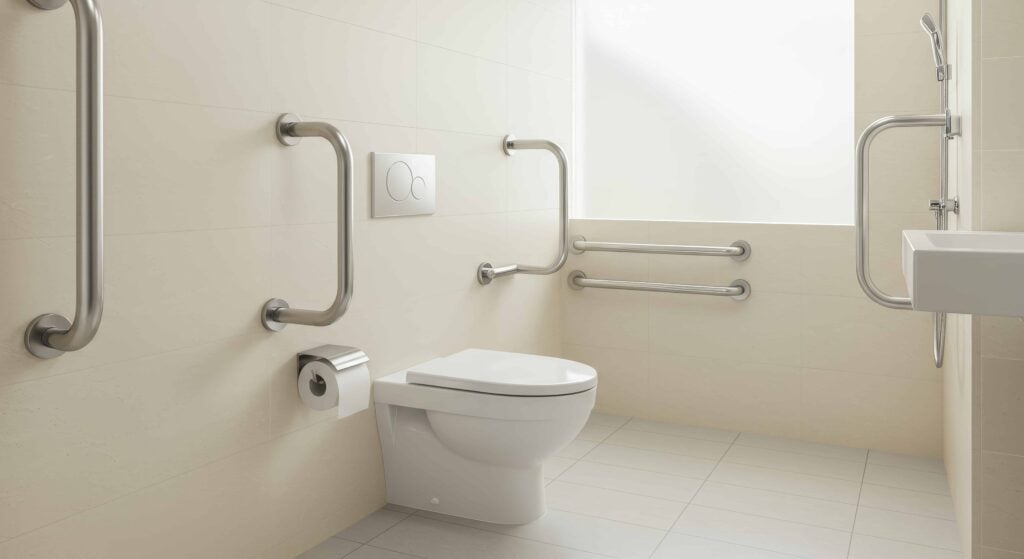
For a toilet to really be considered barrier-free, certain dimensional specifications must be met. For example, the Swiss standard SIA 500 stipulates a minimum depth of 70 cm for the toilet bowl - so that people with disabilities or wheelchair users have enough space to use the toilet without restriction. The side access areas should be at least 95 cm wide on the left and right, depending on use. The recommended seat height measured from the floor is 46-48 cm, which makes it easier to transfer safely from the wheelchair to the toilet. Toilet roll holders must be installed within the side reach zone next to the toilet, ideally in conjunction with a Folding support handle, which, like the toilet flush and flush release, must be ergonomically planned and implemented. This ensures safe and independent access. The right side is also crucial: the holder must be installed on the opposite side to the transfer. There should also be a space of at least 120 x 120 cm in front of the toilet so that manoeuvring with a rollator or wheelchair is possible. It also makes sense to consider access to the toilet, for example by using wider doors and threshold-free transitions.
Our experts at Armatron will be happy to advise you on the individual realisation of your conversions or new builds, give you tips and offer you customised products and solutions that comply with standards, are of high quality and at the same time attractive. If you require any information, please do not hesitate to contact us. Contact with us.
The most important masses summarised once again:
-
- Seat height: 46-48 cm
- WC bowl depth: min. 70 cm
- Lateral movement areas: at least 95 cm on the left and right (when transferring from the side)
- Front movement area: min. 120×120 cm
- Side grab handles: foldable, height 75 cm (upper handle section)
- Distance between the grab rails: 65-70cm
- Controls (e.g. flush): easily accessible when seated, max. height 120 cm
Planning principles: the SIA 500 standard
This standard defines the central requirements for barrier-free construction in Switzerland and therefore also provides information on the correct dimensions for barrier-free toilets. It not only applies to public buildings, but also serves as an essential basis for private residential construction, especially for future-oriented utilisation concepts. Particular attention must be paid here to the movement areas around the toilet, which should ensure free accessibility, the reachability of all components and the correct positioning of aids, such as backrests. The aim is to enable people with limited mobility to use the toilet without assistance. Anyone who wants or needs to plan barrier-free facilities should therefore check in advance whether the structural conditions, such as the appropriate room size, door widths and installation heights, meet the relevant requirements.
Good to know: In Germany, the DIN 18040-1 standard applies, which is not officially used in Switzerland, although it is often used as a guide in specialist circles. However, Swiss planners and architects must always adhere to SIA 500, as it is binding for barrier-free construction and building projects with a building permit. The German standard deviates from the Swiss specifications in some areas, usually stipulating slightly smaller dimensions. In Switzerland, there is also a stronger focus on the side transfer areas and the use of the sanitary room in wheelchairs.
More than standard: customised solutions for individual requirements
Whether renovation, conversion, retrofitting or a completely new build - whether in existing buildings, hotels, public facilities, for the residents of a care facility or in the private sector - every structural situation brings its own unique challenges. This is why it is so important to never rely on off-the-shelf products and sanitary solutions, but on customised concepts. If you want to play it safe when it comes to accessible toilets and toilet facilities, opt for toilet systems with a wide range of equipment options and full accessibility. Armatron is exactly the right partner for you, because we offer the integration of different heights, depths, handles and flushing mechanisms - always exactly as the environment and your requirements demand. Our barrier-free sanitary solutions are the result of a clear understanding of our customers' needs. This is how we develop products that really improve the everyday lives of people with limited mobility.
Why Armatron?
Our barrier-free WCs not only offer safety and independence for users. They also impress with their first-class design and manufacture, high-quality materials and attractive design language. We also offer a wide range of designs: Stainless steel and easy-to-clean surfaces guarantee a particularly long service life and easy maintenance. Models such as the Floor-standing WC 700 P with extended basin or the Wall-hung WC 700 S have been specially developed for barrier-free requirements and fulfil both functional and aesthetic demands at the highest level. Armatron stands for a high quality promise - from the initial planning to the selection of suitable equipment. Our WC solutions are not only tailored to current requirements, but can also be flexibly integrated into future sanitary concepts. Solutions that will last for years - always technically up to date, reliable in use and function and always stylistically convincing. Put your trust in our experience, our expertise and our passion - for a barrier-free bathroom or WC that gives people the space they really need.